Adversarial Animation is a summer school at Tampere University of Applied Sciences (TAMK), co-organized by Vilnius Gediminas Technical University, Academy of Media Arts Cologne, and Köln International School of Design.
Continue readingVirtual Realities at German Architecture Center, Berlin

Rethinking Knowledge-Sharing in Design at Loughborough University
I will speak about the development of a journal of integrated design research at KISD in an online-talk at Loughborough University, invited by Loughborough Open Research Collective.
Continue readingLearning to Fail at DEL in Between

At DEL in Between of the Digitally Engaged Learning Conference, Laura Popplow, Laura Wagner and I will speak about “Learning to Fail at Design, AI, and Technology.”
Continue readingColossal Cave Adventure — The Movie at VRAL

Our project Colossal Cave Adventure — The Movie is shown in an online screening at VRAL, accompanied by an interview with Thomas Hawranke and myself. The screening was curated and the interview was conducted by Matteo Bittanti.
Continue readingWalking the dog in latent space at University of Bochum
Presentation with Thomas Hawranke
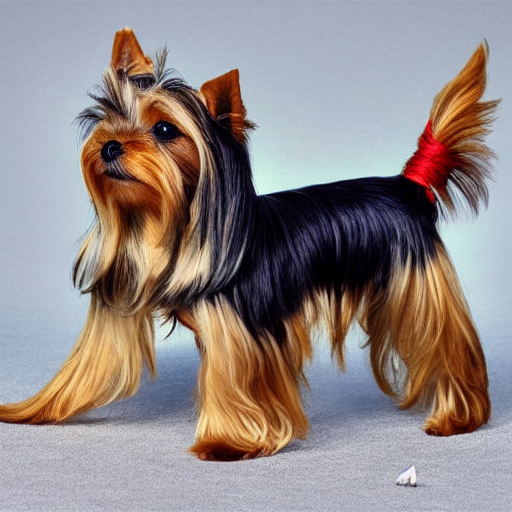
As part of a Menagerie of Virtual Animals at the University of Bochum, Thomas Hawranke will present some work-in-process in which we approach the latent space of neural network image classification and generation by looking at the Yorkshire Terrier. Under the title “Gassi gehen im latent space / Walking the dog in latent space” we will try to shed some light on the technological and cultural role of animals (and the Yorkshire Terrier in particular) in contemporary artificial intelligence.
Correlations Forum at HfG Offenbach
As part of the KITeGG research project, I am attending Correlations. Forum for AI in Art and Design at HfG Offenbach on November 9-11, 2022. The event includes an exhibtion featuring work of KISD alumni Johannes Growe, Lisa Marleen Mantel and Laura Juliane Wagner.
Continue reading“Some Kind of Actual Space” oder: Cyberspace als kybernetischer Raum
Lasse Scherffig: “Some Kind of Actual Space” oder: Cyberspace als kybernetischer Raum, in: Carolin Höfler, Philipp Reinfeld (eds.): Mit weit geschlossenen Augen. Virtuelle Realitäten entwerfen, Brill | Fink, 2022, 81-104 (https://doi.org/10.30965/9783846767047_006)
Colossal Cave Adventure — The Movie
Animation, 2022
With Thomas Hawranke
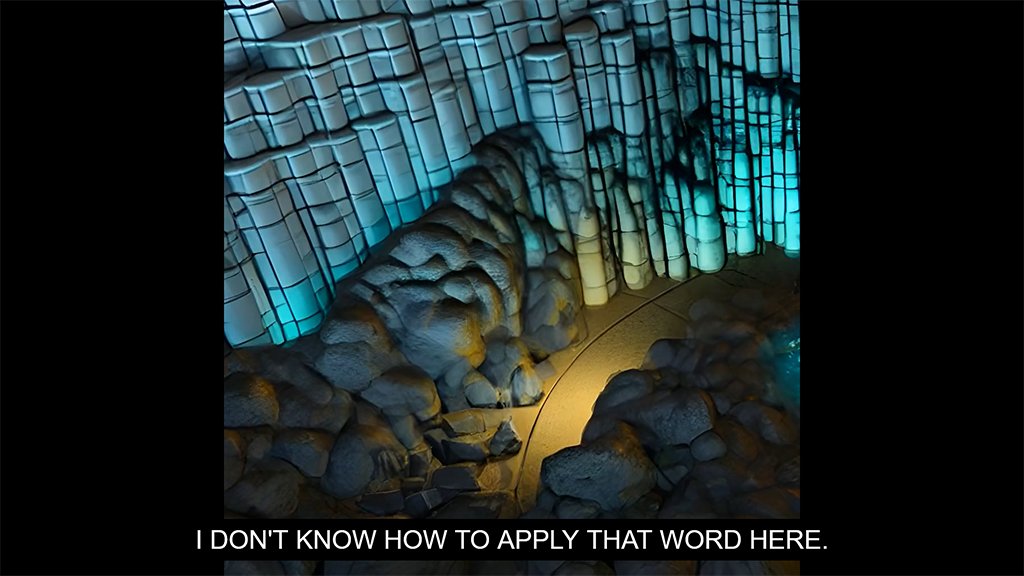
The project deals with one of the first text-based adventure games in computer game history. Colossal Cave Adventure was developed by Will Crowther in 1976 and is based on the spatial presence of Mammoth Cave in Kentucky. Crowther’s game completely avoids a visual representation of the cave – instead, text input and text response shape the cave in the player’s individual perception. The AI-based animated film is approximately 55 minutes long. The camera constantly moves downwards, digging through geological layers and exposing new cave spaces again and again. Every eight seconds, the AI system receives a new textual description. These descriptions are taken from the 1976 source code of the game, which contains a total of 379 inputs ranging from narrative descriptions of nature, to jargon from the vocabulary of speleologists, to single words meaning an object, a compass direction, or an exclamation.
Continue readingHidden Layers Summer School
At Köln International School of Design, we are hosting the summer school Hidden Layers from July 18 to 22. The event gathers a diverse group of experts to collectively discuss and learn about artificial intelligence in design. It is held by the research project KITeGG on design and AI and combines a public program with talks, an exhibition and workshops with internal meetings of the five art and design schools that are part of the project
Continue reading